Let’s not jump to conclusions.
A LOT of marketers are being misled right now.
In this edition:
- 🚨 Google just nuked self-promotional listicles (but not all of them)
- 😳 Google searches down 20% per user, but it’s not what you think
- 🗞️ Stories to not doomscroll

🚨Did Google just nuke self-promotional listicles? (Not really.)
Last week, SEOs were cranking out “Best [Product]” listicles and ranking themselves #1.
This week, they’re panic-deleting them…?
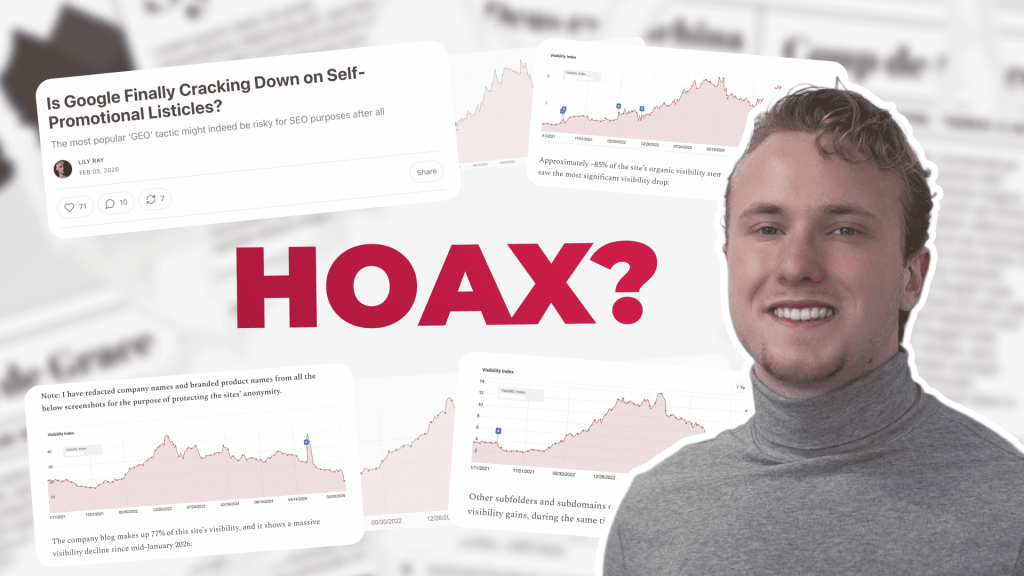
All because Lily Ray published an article that highlighted several major SaaS websites with 30-50% visibility drops in mid-January, noting many of the hardest-hit sites had hundreds of self-promotional listicles.
Now, a lot of marketers believe:
“Google is cracking down on listicles.” “Manual penalties are coming.” “Stop publishing best-of content.”
Let’s slow down.
Yes, it’s probably true… Some really big B2B SaaS companies lost HUGE amounts of traffic, and they had hundreds of self-promotional listicles.
But there’s nuance everyone is missing.
Google didn’t “ban listicles.” They’re still showing up in AI Overviews as citations (influencing brand mentions in AI answers) and traditional SERPs. Check for yourself.
What’s really happening: Google hit scaled, low-substance, AI-regurgitated spam listicles that companies were trying to use to manipulate AI answers.
There’s a big difference.
Most of the “penalized” content shares other red flags:
- Artificial date refreshing (“2025” → “2026” with no meaningful updates)
- Thin programmatic templates stamped across hundreds of BOFU variations
- AI-generated content at scale (multiple articles returned 100% AI confidence scores)
- Fake E-E-A-T (authors “publishing” 50–70 articles per month)
- No comparison tables
- No pricing breakdowns
- No methodology
- No honest competitor analysis
- No human element
That’s NOT “publishing helpful content” (what Google wants at the end of the day).
That’s spamming LLM visibility.
Listicles are still a powerful strategy if your content has:
- Real comparison tables (pricing, features, use cases)
- Category-specific wins (“Best for enterprise,” “Best free option”)
- Honest limitations about your own product
- Balanced competitor breakdowns
- Named authors with credentials
- Clear evaluation methodology
- Depth beyond the list (FAQs, buyer considerations, decision criteria)
- Personal experience woven in
Google isn’t going to hand out manual penalties for publishing helpful content.
They’re going to suppress scaled manipulation.
BIG DIFFERENCE.
Now, let me tell you the real truth about listicles: Since July, Google has deprioritized ranking B2B SaaS brands’ product listicles. The reason for this is obvious: THEY’RE GOING TO BE BIASED.
Today, BOFU SERPs are dominated by independent blogs, landing pages, and social/forum posts.
But within the AI Overviews, the B2B SaaS brands’ listicles are still being used as AI citations, meaning your listicles will STILL influence AI answers.
That right there shows you the path you should take:
- Reach out to independent blogs that rank to see if you can negotiate a listing for your brand.
- Publish hyper-specific landing pages (this trains LLMs and gives you a chance to rank)
- Publish more “SEO-optimized” offsite content on YouTube, Medium, and LinkedIn. Maybe even turn this into an influencer marketing play, where you pay industry influencers to publish the content for you. Or leverage affiliate marketers…
- KEEP publishing honest, high-quality, in-depth Product listicles to influence AI answers.
You’re welcome!
😳 Google searches down 20% per user, but it’s not what you think
U.S. users ran nearly 20% fewer Google searches in 2025 than the year before.
New data from Datos/SparkToro reveals Google isn’t losing users. It’s losing repeat searches. People are searching less because AI-powered results answer their questions faster, so they don’t need to search again.
The numbers:
- Desktop searches per user: down ~20% YoY in the U.S.
- Zero-click searches: leveled off in the low-20% range. The behavior has stabilized.
- AI tools (ChatGPT, Gemini, etc.): account for 0.77% of total desktop activity. Tiny, but growing.
- Google’s AI Mode: accounts for just 0.06% of searches.
How search behavior is changing:
- Mid-length queries (6-9 words) are exploding. People are getting comfortable typing full questions instead of keywords.
- Very long queries (15+ words) are rare but volatile. Users are experimenting with conversational prompts.
- Fewer follow-up searches. After one search, there’s less “hmm let me Google that three more times.”
Traffic is concentrating like never before. The same handful of sites dominate post-search destinations:
- YouTube, Reddit, Amazon, Wikipedia, Facebook still own the game
- ChatGPT cracked the top 7 (one of the only movers)
- Quora dropped out of the top 15 entirely
For publishers relying on search traffic, this is a nightmare. Fewer searches per user = fewer chances to get clicks, even if total search volume looks stable.
Translation? AI is making search brutally efficient. Which is great for users. Not so great if your business model depends on people clicking through to find answers.

🔥 Adding value
Posted 4 hours after the original went viral.

🗞️ Stories to not doomscroll
LinkedIn saw 60% decline in awareness traffic as AI answers dominate. The company now tracks mentions, citations, and visibility in AI answers instead of traffic.
Google revised Discover guidelines alongside its February core update. The documentation now explicitly calls out clickbait and sensationalism while adding page experience guidance.
OpenAI started testing ads in ChatGPT for free users. Ads appear separately from chat responses with user controls for personalization and opt-out.
Patents reveal how AI search interprets intent, evaluates passages, and builds brand context. Google and Microsoft documents detail query fan-out, LLM readability, and entity characterization.
AI forms brand perception from market consensus before buyers contact you. Consistent delivery across every touchpoint now matters more than controlled positioning.
Context matters more than data in personalization. When brands design experiences around what a customer is actually trying to do in that moment, people are 2.3x more likely to complete important decisions.
Video and AI search drive most engagement at 82% and 79%. NP Digital survey of 500 marketers shows that onsite content captures just 27% of audience attention.

🤝 Need content marketing that actually gets paying customers?
I run Stat Digital, a fractional content marketing team for B2B SaaS companies.
We can help you:
- Create content that captures ready-to-buy leads from AI Search and SEO.
- Launch and run newsletters to nurture the thousands of neglected contacts going stale in your CRM (like this one)
👉 Want to uncover your top opportunities to generate new customers from your content? Schedule a free strategy session here.

Thanks for reading! See ya next week.
~ Jacob Statler