It’s safe to say what worked perfectly last year for SEO no longer works the same today.
The first 2 stories in this newsletter highlight my BIGGEST findings for adapting.
In this edition:
- 🔍 How I’m building out new marketing plans for AI search domination
- 📈 Why a one-person blog now beats faceless B2B company content in search
- 🧪 The quiz lead magnet that added 15k+ subscribers

🔍 How I’m building out new marketing plans for AI search domination
I have been rebuilding how I approach bottom-of-funnel search for our clients.
Traditional SEO tactics are still a major factor. But once AI Overviews rolled out to almost every query in July, they became the real entry point for capturing high-intent buyers for 2 main reasons:
1) AI Overviews have drastically decreased clicks for every site ranking on the first page of Google.
2) Since July, Google seems to be prioritizing 3rd-party bloggers’ listicles for “best [type of] software” results over SaaS companies’ same type of blog posts. (Just do a few B2B BOFU searches to see what I mean.)
So this leaves B2B companies with less traditional SERP space, increasing the importance of having your brand name surfaced in the AI Overview instead.
The first step is understanding what you’re actually competing for. Most companies have only a small set of real BOFU keywords that can generate revenue directly. Not informational queries, but the keywords people search when they’re ready to choose a product.
For most clients, that list might only be 10 to 30 keywords (depending on target industries and product features). Once I map those, I analyze the SERP for each one and start reverse engineering WHAT brands AI Overviews mentions and WHY.
Here’s what I look for with each BOFU search:
- Which sites the AI Overview cites (citations and brand mentions are entirely different).
- I search and count how many listicles each brand is mentioned in for each BOFU keyword.
- What shows up underneath: blogs, YouTube videos, LinkedIn posts, Medium articles, forum threads, etc.
- How deep the cited sites go on that topic, based on a quick site search of how many related pieces they’ve published.
That gives me a clear picture of both the formats Google favors and the depth of content needed to be trusted as an authority. The SERP is way more diverse now than it used to be, and you can’t build your plan around a single blog post anymore.
Those BOFU listicles are the most significant factor for helping AI decide which brands to mention. Analyzing them gives you:
- A rough estimate of how many brand mentions you need to match competitors.
- A mapped list of blogs to pitch for inclusion.
Once this process is done for every BOFU keyword, the plan becomes measurable instead of guesswork. You know how much supporting content to create, what type of content to create (and where to publish it), how many mentions and links to aim for, and which specific pages are directly influencing today’s AI Overviews.
From there, your goal will be to get mentioned in the sources that already shape the AI Overview, or you create content strong enough to replace them. That’s the part of search that’ll actually drive revenue going forward.

📈 Why a one-person blog now beats faceless B2B company content in search
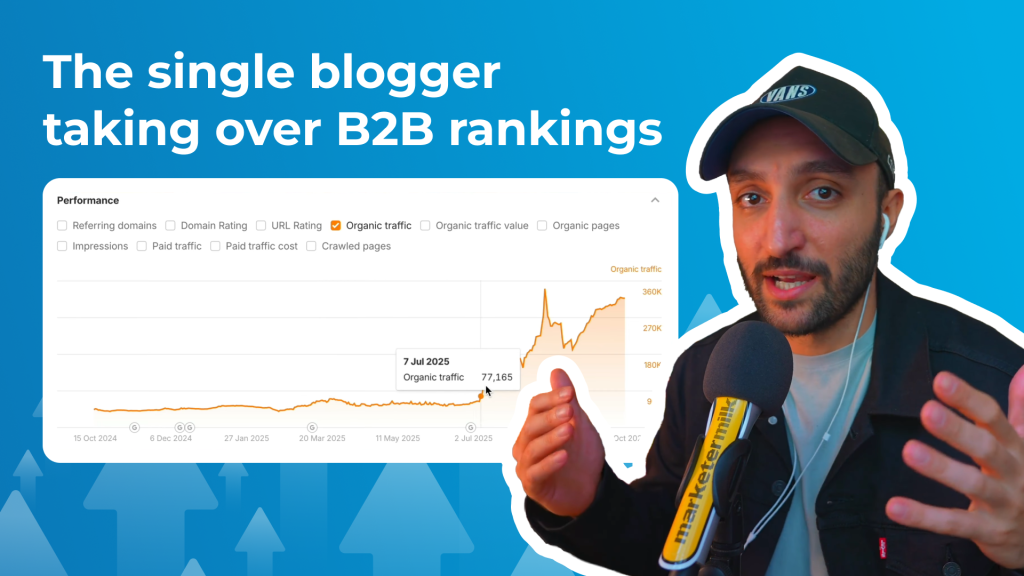
Since the July Google Core Update, I’ve seen MarketerMilk, an independent blog run by one person, rank highly on almost every B2B SaaS (marketing-related) BOFU search, replacing the rankings of many company blogs with similar content.
This single solo creator, Omid G, is suddenly a bigger SEO competitor for many of my clients than their big-budget direct competitors.
After some digging, I came across his YouTube, where he basically explains why his own site is winning top rankings while most B2B company blogs have slid to page 2:
- He focuses on BOFU searches buyers use right before they pick a tool, then builds deep content around those (he monetizes with affiliate links).
- He leans hard into EEAT, writing based on real experience that is obvious to readers.
- His titles are more like a top YouTube channel’s instead of a traditional “SEO title”, using first-person hooks such as “I tested these tools for 6 months,” then actually delivers proof in the content.
- He pairs original YouTube videos with key posts and embeds them, which increases the average time on page (helping rankings) and builds trust by showing his content is real, not AI-generated.
Although I’m pretty convinced that a lot of these independent bloggers are being pushed up in the BOFU rankings algorithmically (because Google wants less-biased BOFU results), MarketerMilk is a perfect example of what Google wants in the content it ranks.
🧪 The quiz lead magnet that added 30k+ subscribers
Do lead magnets still work? Milly Tamati built one that added 30k+ email subscribers, including 15k net new, and turned Generalist World into a multi-6-figure business. And it happened because her audience kept asking the same question: “What kind of generalist am I?”
She turned that identity gap into a diagnostic quiz, partnered with a community member who understood assessment logic, and put it on generalistquiz.com instead of a subpage. That tiny decision made it feel like a product, not a form.
Why the quiz worked so well:
- It solved a specific identity problem her audience already talked about.
- Putting it on its own domain made it easy to remember and easy to say on video.
- The results were detailed enough that people shared them, calling it “spooky accurate.”
Once the quiz existed, TikTok became the growth engine. She posted quick, imperfect clips that put the quiz front and center.
- One video alone added 3,668 subscribers.
- She posted 192 TikToks, but growth only spiked after the quiz launched.
- Cross-posting and repetition kept the link circulating everywhere her audience looked.
The best part is how the quiz plugged into everything else. Podcast interviews. Social bios. Email CTAs. Word of mouth. People kept sharing it because it actually told them something useful.
For B2B teams, a dynamic lead magnet can be perceived as more valuable than the classic PDF. If your buyers keep asking the same question, create a quiz that answers it.
You get more top-of-funnel awareness for your brand AND email subs that you can reach without paying for ads or relying on a social algo.
Which you can then nurture with a weekly newsletter!

😁 Discovering AI search in 2024

Realizing it killed your traffic in 2025

🗞️ Stories to not doomscroll
In one audit, 72% of pages ChatGPT cited had a short answer capsule up top. Keep that block link free and data-rich if you want visibility from LLMs.
Creator ad spend will jump 26% to $37B this year, while nearly half of marketers call creator content a must-have. Yet 95% worry AI scaling will hurt authenticity even as most already rely on it.
Gemini 3 just landed in Google’s AI Mode, turning search into a smarter, more interactive answer layer. It fans out more queries and builds dynamic layouts, changing how and where your content appears.
LLMs.txt is basically overhyped, not an AI visibility hack. Just 1 in 10 sites use it, and a 300k domain study found no measurable impact on AI citation rates.
Google is officially stuffing ads into AI Mode answers. The test is ramping up fast, turning AI responses into a real ad surface and giving early adopters a brief window of cheaper, less crowded clicks.
Search Console finally separates branded from non-branded demand. Google is rolling out a branded query filter and Insights card so you can see clicks, CTR, and position for branded keywords.

🤝 Need a hand with your content marketing?
I run Stat Digital, a fractional content marketing team for B2B SaaS companies.
We can help you:
- Create blogs that capture ready-to-buy leads from SEO.
- Launch and run newsletters to nurture the thousands of neglected contacts going stale in your CRM (like this one)
Want to uncover your top opportunities to generate new customers from your content? Schedule a free strategy session here.